Best Deodorant for Sensitive Skin: What to Look Out For
A complete guide to choosing deodorant for sensitive skin - ingredients to avoid, what actually works, and how to find products that won't irritate your underarms.
If your underarms frequently feel irritated, itchy, or uncomfortable after applying deodorant, you’re not alone. Sensitive underarm skin is incredibly common—and finding a deodorant that actually works without causing reactions can feel like an endless quest.
The good news? Once you understand which ingredients cause problems and which ones help, finding your perfect match becomes much simpler. This guide breaks down everything you need to know about choosing deodorant for sensitive skin.
Why Underarms Are So Sensitive
Before diving into ingredients, it helps to understand why underarm skin is particularly prone to irritation.
The Unique Underarm Environment
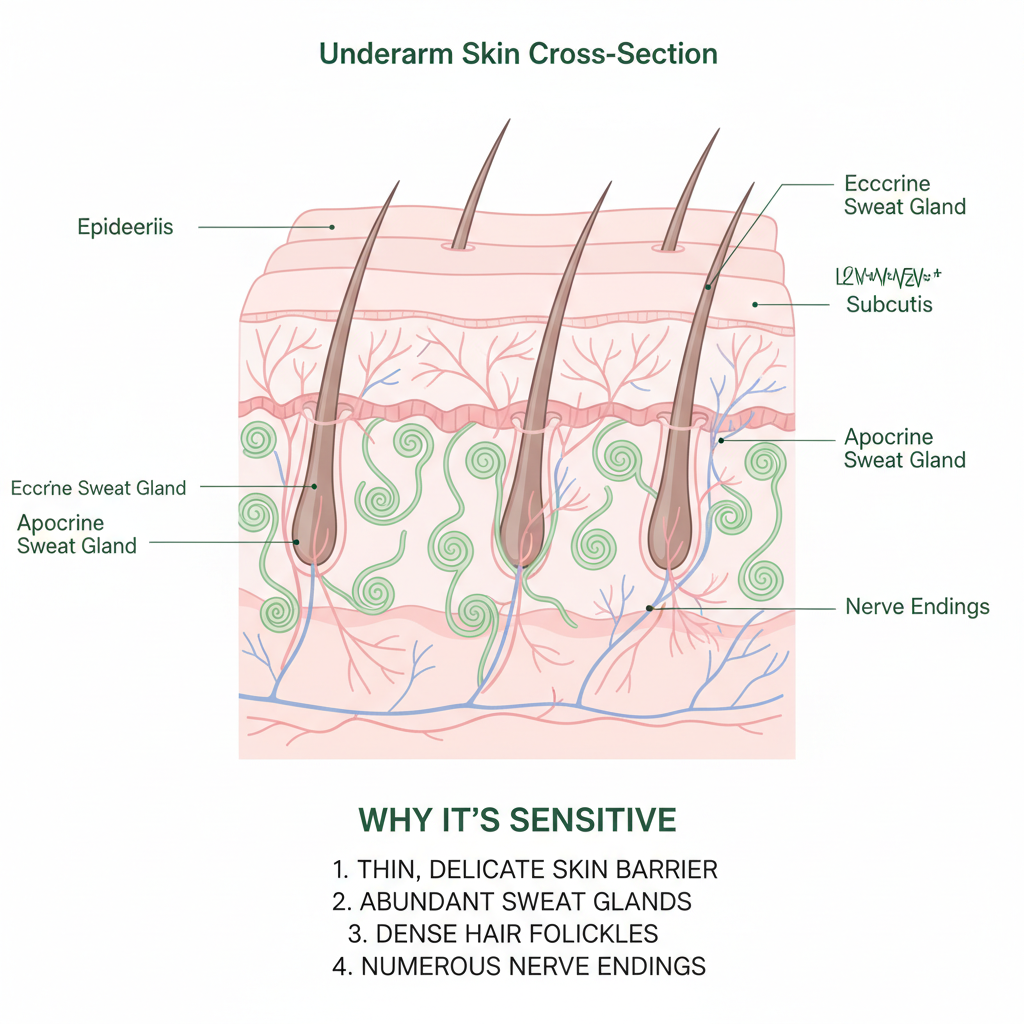
Your underarms are unlike any other part of your body:
Thin, delicate skin — The skin in your armpit is thinner than most other areas, making it more permeable and reactive to topical products.
Constant friction — Your arms move against your body thousands of times daily, creating ongoing mechanical irritation.
Warm, moist conditions — Sweat glands are concentrated here, creating a humid environment where bacteria thrive and products can react differently.
Frequent shaving — For those who shave, regular hair removal creates microscopic cuts and compromises the skin barrier.
Lymph node proximity — The high concentration of lymph nodes can make this area more reactive to certain substances.
Common Causes of Deodorant Irritation
When your deodorant causes problems, it’s usually due to one or more of these factors:
- Ingredient sensitivity — Your skin reacts to specific substances
- pH disruption — Products alter your skin’s natural acid balance
- Barrier damage — Ingredients strip protective oils or dry out skin
- Allergic reactions — True allergies to fragrances or preservatives
- Mechanical irritation — Product texture or application method
Ingredients to Avoid
If you have sensitive skin, these are the ingredients most likely to cause problems.
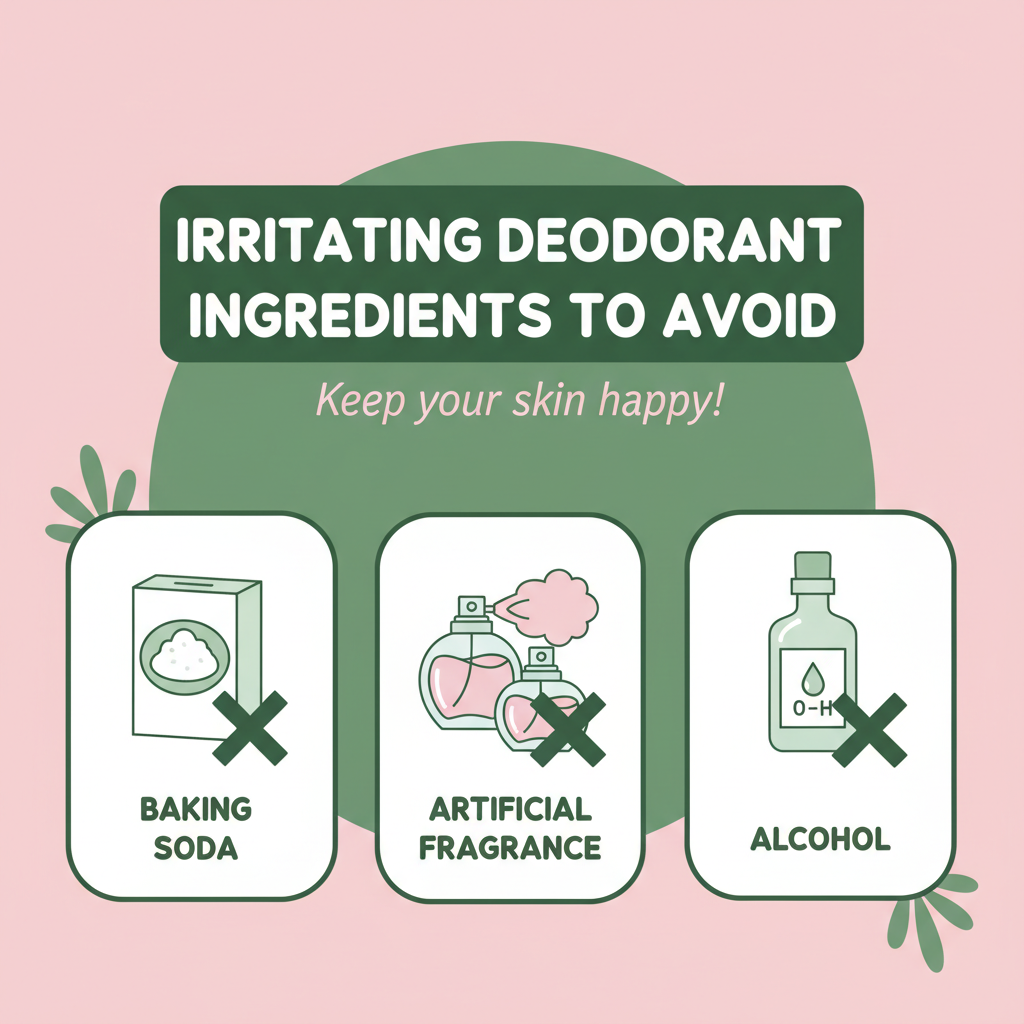
Baking Soda (Sodium Bicarbonate)
The issue: Baking soda has a pH of 8-9, while your skin sits at 4.5-5.5. This significant pH mismatch can disrupt your skin’s acid mantle, leading to irritation, redness, and even chemical burns in severe cases.
Who’s affected: Estimates suggest 20-30% of people react to baking soda in deodorant, though many more experience subtle irritation they don’t connect to the ingredient.
What to look for: “Sodium bicarbonate” on the ingredients list—it’s often in the top five ingredients of natural deodorants.
Artificial Fragrances
The issue: Synthetic fragrances are one of the most common causes of allergic contact dermatitis. They can contain hundreds of individual chemicals, any of which might trigger a reaction.
Who’s affected: An estimated 1-4% of the population has fragrance allergies, but many more experience irritation without full allergic reactions.
What to look for: “Fragrance,” “parfum,” or “perfume” on labels. These terms can hide numerous synthetic ingredients.
Aluminium Compounds
The issue: Found in antiperspirants, aluminium salts can cause irritation—particularly after shaving when the skin barrier is compromised. Some people also develop granulomas (small lumps) with long-term use.
Who’s affected: Those with very sensitive or eczema-prone skin are most likely to react.
What to look for: Aluminium chloride, aluminium chlorohydrate, aluminium zirconium.
Alcohol (Ethanol/Denatured Alcohol)
The issue: While alcohol helps products dry quickly and has antibacterial properties, it can be incredibly drying and irritating—especially with repeated use.
Who’s affected: Anyone with dry or sensitive skin, but particularly those who apply deodorant after shaving.
What to look for: “Alcohol,” “alcohol denat,” “ethanol,” or “isopropyl alcohol” high on the ingredients list.
Propylene Glycol
The issue: This common ingredient helps products glide on smoothly and penetrate skin, but it can cause allergic reactions in some people and general irritation in others.
Who’s affected: Estimated 0.8-3.5% of people have sensitivity to propylene glycol.
What to look for: “Propylene glycol” or “1,2-propanediol” on labels.
Preservatives
The issue: Certain preservatives, particularly parabens and methylisothiazolinone (MI), are known sensitisers that can cause reactions even after years of uneventful use.
Who’s affected: MI in particular has become a significant cause of contact dermatitis, with sensitisation rates increasing.
What to look for: Methylisothiazolinone, methylchloroisothiazolinone, parabens (methylparaben, propylparaben, etc.).
Ingredients That Work for Sensitive Skin
Now for the good news—plenty of effective ingredients are gentle enough for even the most reactive skin.
Magnesium Hydroxide
Why it works: This has become the gold standard for sensitive skin deodorant. It neutralises odour-causing acids similarly to baking soda but with a gentler pH that’s closer to your skin’s natural level.
Effectiveness: Highly effective for odour control. Many people find it works as well as baking soda without the irritation.
Found in: Wild Sensitive, Native Sensitive, and many other “sensitive” formula natural deodorants.
Zinc Compounds
Why they work: Zinc ricinoleate and zinc oxide have natural antibacterial properties and can neutralise odour molecules directly. They’re well-tolerated by most skin types.
Effectiveness: Good for odour control, though sometimes less powerful than baking soda or magnesium.
Found in: Various natural and conventional deodorants.
Arrowroot Powder
Why it works: A gentle, naturally derived starch that absorbs moisture without irritating skin. It helps keep underarms feeling dry and comfortable.
Effectiveness: Excellent for moisture absorption, though it doesn’t actively fight odour.
Found in: Most natural deodorants as a supporting ingredient.
Tapioca Starch
Why it works: Similar to arrowroot, tapioca starch absorbs moisture gently and creates a smooth application feel without irritation.
Effectiveness: Great for moisture management and improving product texture.
Found in: Many natural deodorants alongside other active ingredients.
Coconut Oil
Why it works: Has natural antibacterial properties (due to lauric acid content) while also moisturising and protecting skin.
Effectiveness: Moderate antibacterial action, excellent for skin conditioning.
Caution: Some people are sensitive to coconut oil—do a patch test first.
Shea Butter
Why it works: Rich in vitamins and fatty acids that nourish and protect skin. Creates a barrier that can help protect against irritation from other ingredients.
Effectiveness: Primarily for skin health rather than odour control.
Found in: Many cream and balm-style natural deodorants.
Aloe Vera
Why it works: Known for its soothing, anti-inflammatory properties. Can help calm irritated skin while providing light moisture.
Effectiveness: Excellent for sensitive skin comfort, minimal odour-fighting properties.
Found in: Many sensitive skin formulations.
Choosing the Right Format
The format of your deodorant matters just as much as the ingredients—especially for sensitive skin.
Cream/Balm Deodorants
Pros:
- Often more moisturising
- Can use fingertip application for gentler pressure
- Usually fewer filler ingredients
Cons:
- Requires touching product with fingers
- Can feel greasy if over-applied
- May take longer to absorb
Best for: Very dry or extremely sensitive skin
Stick Deodorants
Pros:
- Familiar, convenient application
- Less mess
- Usually dry quickly
Cons:
- Can tug at skin if too firm
- Harder to control application pressure
- May contain more binding agents
Best for: Those who want convenience with good sensitivity
Roll-On Deodorants
Pros:
- Liquid formula can feel lighter
- Easy, even application
- Often quick-drying
Cons:
- Need to wait for drying before dressing
- Applicator can harbour bacteria
- May feel wet initially
Best for: Those who prefer a light, non-greasy feel
Spray Deodorants
Pros:
- No direct skin contact with applicator
- Quick application
- Refreshing feel
Cons:
- Harder to control coverage
- May contain more alcohol
- Environmental concerns with aerosols
Best for: Touch-up applications, those with extremely sensitive skin who want no-touch application
Tips for Sensitive Skin Success
Beyond choosing the right product, how you use your deodorant matters enormously.
Application Timing
Wait after shaving — Apply deodorant at least 12-24 hours after shaving. Freshly shaved skin has microscopic cuts and a compromised barrier, making it far more likely to react.
Apply to dry skin — Moisture on your skin can change how products absorb and react. Ensure underarms are completely dry after showering.
Let skin cool — Wait a few minutes after a hot shower for your body temperature to normalise before applying.
Application Technique
Use light pressure — Pressing hard won’t improve effectiveness but can irritate skin.
Less is more — 2-3 swipes is usually sufficient. Over-application wastes product and increases irritation risk.
Allow to absorb — Wait 30-60 seconds before dressing to let the product set.
Ongoing Care
Moisturise at night — Apply a gentle, fragrance-free moisturiser to underarms before bed. Healthy, hydrated skin is more resilient.
Gentle cleansing — Avoid harsh scrubbing. A gentle cleanser and soft washcloth is all you need.
Give products time — If a new deodorant doesn’t cause immediate irritation, give it 1-2 weeks before deciding if it works for you. Your skin may need time to adjust.
One change at a time — When trying new products, don’t change anything else in your routine simultaneously. This way you’ll know exactly what’s causing any reaction.
Patch Testing Protocol
Never skip patch testing when you have sensitive skin. Here’s the proper method:
Step 1: Choose Your Test Area
Apply a small amount to the inside of your elbow or the soft skin on your inner upper arm. These areas approximate the sensitivity of underarms.
Step 2: Wait and Watch
Leave the product on for 24 hours. Check for:
- Redness
- Itching
- Bumps or rash
- Burning sensation
- Any discomfort
Step 3: Repeat
If no reaction after 24 hours, repeat the test for another 24 hours. Some reactions are delayed.
Step 4: Trial Application
If both patch tests pass, try applying to one underarm only for 2-3 days before using on both.
Step 5: Full Use
If all goes well, proceed with normal use—but continue monitoring for the first few weeks, as sensitisation can sometimes develop over time.
When to See a Doctor
While most deodorant irritation is manageable with product changes, some situations warrant medical attention:
See a doctor if:
- Irritation doesn’t improve after stopping the product for a week
- You develop a spreading rash or hives
- There are signs of infection (pus, increasing pain, fever)
- Skin becomes cracked or broken
- You experience severe pain or burning
- Underarm irritation is accompanied by irritation elsewhere
A dermatologist can help identify specific allergies through patch testing and may recommend prescription treatments for damaged skin.
Finding Your Match
The natural deodorant market has evolved significantly, with many brands now offering dedicated sensitive skin lines.
Brands with Excellent Sensitive Options
Wild Sensitive — Uses magnesium instead of baking soda, available in multiple gentle scents
Native Sensitive — Baking soda-free formula with good scent variety
Fussy Sensitive — Refillable option with a gentler formula
Schmidt’s Sensitive — One of the original sensitive natural deodorant lines
What to Look for on Labels
✓ “Baking soda free” or “bicarbonate free” ✓ “Fragrance free” or “unscented” ✓ “Sensitive” or “gentle” formulation ✓ “Dermatologist tested” ✓ Short, recognisable ingredient lists
What to Approach with Caution
⚠ “Natural” alone doesn’t mean gentle ⚠ Essential oils can still cause reactions ⚠ “Unscented” products may still contain masking fragrances ⚠ “Dermatologist recommended” doesn’t mean tested for sensitivity
The Bottom Line
Sensitive skin doesn’t mean you’re destined for deodorant disasters. With the right knowledge about ingredients and proper application techniques, you can find products that keep you fresh without the irritation.
The key principles to remember:
- Know your triggers — Pay attention to patterns in what causes reactions
- Read labels carefully — Avoid known irritants like baking soda and synthetic fragrances
- Seek out gentle actives — Magnesium hydroxide and zinc compounds are your friends
- Application matters — Timing and technique can prevent reactions
- Patch test everything — A few days of testing can save weeks of discomfort
Your underarms deserve products that work with your skin, not against it. Finding the right deodorant might take some experimentation, but comfortable, irritation-free freshness is absolutely achievable.
Ready to find your sensitive skin match? Browse our product reviews filtered for sensitive skin options, or take our Find Your Perfect Deodorant quiz for personalised recommendations.